
Intrauterine device (IUD)
What is an IUD?
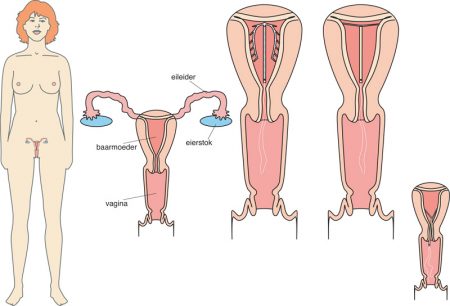
The IUD is a small plastic anchor-shaped device (24 to 36 mm long) that is placed in the uterus to prevent pregnancy. It has two threads attached that hang from the cervix. These threads are needed to remove the IUD later. During intercourse, you and your partner will not notice the IUD.
After removal of an IUD, you can become pregnant again quickly. IUDs do not protect against sexually transmitted infections.
There are different types of IUDs. The two most commonly used types are the copper IUD (wrapped with copper wire) and the hormonal IUD (which releases the hormone progestogen). Both IUDs are very reliable.
How does the IUD work?
The copper IUD
- Makes the uterine lining unsuitable for implantation of a fertilised egg.
- Renders the sperm cells that enter your uterus infertile.
- Is reliable: of every thousand women who use the copper IUD, a maximum of ten per year still become pregnant.
- Is effective immediately from the moment of insertion.
- Remains effective for ten years (depending on the type of copper IUD).
The hormonal IUD
- Releases a very small amount of hormone (progestogen). Much less progestogen enters the bloodstream than with other hormonal contraceptives. Progestogen makes the uterine lining unsuitable for implantation of a fertilised egg.
- Makes the cervical mucus less permeable to sperm cells.
- Is very reliable: of every thousand women who use the hormonal IUD, one or two per year still become pregnant.
- Is effective immediately if inserted during menstruation.
- Remains effective for eight years.
Watch an illustrative video about the hormonal IUD (Mirena) on YouTube.
Who can use an IUD?
An IUD is suitable for almost every woman, even if you have not yet had children.
The copper IUD is less suitable if you already have painful periods or heavy menstrual bleeding. In that case, the hormonal IUD may be more appropriate.
Before the IUD is inserted, you must be certain that you do not have an infection of the vagina, uterus or ovaries.
How is an IUD inserted?
Your GP can insert the IUD for you. You collect the IUD from the pharmacy in advance.
One hour before the insertion, you can take a painkiller. The GP or assistant will, when prescribing the IUD and in consultation with you, also prescribe 2 tablets of naproxen 500 mg. You can take 1 tablet one hour before insertion and, if needed, another 6-8 hours later. Alternatively, you can take paracetamol 1000 mg or ibuprofen 600 mg. If you are still breastfeeding, you may only use paracetamol.
The IUD is usually inserted during or just after menstruation. You are then certainly not pregnant, and the IUD is immediately effective. If you want an IUD after giving birth, it can be inserted from 6-8 weeks after delivery, even if you have not yet menstruated.
If there is a suspicion or risk of an STI, an STI test must first be taken before the IUD is inserted; the test results must be awaited. Read more on our STI page.
The insertion
You lie down with your legs apart. First, the position of your uterus is felt through an internal examination. Then the speculum (duck-bill) is inserted into the vagina to be able to see the cervix clearly. The cervix is grasped with a special forceps. The depth of the uterus is measured with a probe. This may cause an unpleasant sensation. Then the IUD is pushed in through a thin tube. The tube is withdrawn and the threads are trimmed to length.
What are the side effects?
The copper IUD
- Usually causes periods to last somewhat longer than you were used to, and may cause more blood loss and cramping.
- May also cause some bleeding between periods.
- Often causes more (normal) vaginal discharge (white discharge). This is harmless.
The hormonal IUD
- May sometimes cause mild side effects such as tender breasts or slight nausea.
- Usually makes periods less heavy and painful and shorter in duration.
- May also cause some bleeding between periods.
- Often causes periods to stop entirely. This is harmless.
- Often causes more (normal) vaginal discharge (white discharge). This is harmless.
- Contraceptives containing only progestogen do not carry an extra risk of thrombosis (blood clot in the vein) or cardiovascular disease.
Check-ups with the IUD
After insertion of the IUD, there is a small chance that it does not stay in place properly. Therefore, come for a check-up after six weeks.
After that, you can also check yourself whether the IUD is still in place, preferably after your period. If you insert your finger deep into your vagina, you can feel the cervix with your fingertips and, if you feel carefully, the threads of the IUD. If you feel a hard piece in the cervix, that is the arm of the IUD. The IUD is then no longer properly positioned in your uterus. Use a condom temporarily and make an appointment with your GP.
What happens next?
After insertion of an IUD, you may feel slightly dizzy. Once you feel well again, you can go home immediately. It is advisable to take it easy for the rest of the day.
If you took a painkiller beforehand, it will continue to work for a few more hours. If you did not take a painkiller, you can - if needed - still do so afterwards.
Note in your diary when the IUD was inserted, which type of IUD it is, and when it needs to be replaced. It is probably harmless to leave an IUD in place for longer, but it is uncertain whether it will still be effective.
When should you get in touch?
Contact your GP if you experience any of the following in the first days after insertion of the IUD:
- Abnormal discharge
- Persistent abdominal pain
- Fever
The information about contraception is from thuisarts.nl and is based on the NHG guideline Contraception.